

Janome vs Bernina Longarm Quilting Machines
Pricing: What Each Dollar Actually Buys
Prices vary by dealer, configuration, and promotion,
but as of mid-2026 representative street pricing looks like this:
| Model | Approximate Price |
| Janome Quilt Maker 18 + frame | $8,500 |
| Janome Quilt Maker Pro 18 Versa | $8,500 |
| Janome Quilt Maker Pro 18 + full frame | $9,500 or monthly options |
| Bernina Q20 with foldable table | $14,500 |
| Bernina Q20 with 29" cabinet | $15,500 |
| Bernina Q20 on Studio Frame (bundle) | $17,900 |
| Bernina Q20 on PRO Frame | $24,000 |
| Bernina Q24 with frame | $28,000 |
| Bernina Q24 on PRO Frame + Q-matic (bundle) | $38,500 |
The takeaway is stark: a complete Janome 18" longarm-and-frame setup costs roughly what a Bernina Q20 sit-down table model does and less than half of a Q20 on a full PRO frame. Add Q-matic, and the Q24 system pushes past $38,000.
Where Janome wins on value is package completeness: no major add-ons are required to start producing quality quilts on day one, the learning curve is manageable, and parts are widely distributed.
Where Bernina earns its premium is when you genuinely use the advanced features - the BSR refinement, Q-matic automation, and Art & Stitch integration represent measurable advantages for professional and high-volume quilters. A quilter doing mostly freehand work, though, is paying for capability they may rarely touch.
Note: Bernina pricing is dealer-set and not always published online; expect regional variation and frequent seasonal bundles. Janome longarms are more commonly listed with online pricing.
Ease of Use and Learning Curve
Janome leans into simplicity, while Bernina leans into depth. Neither is wrong - they simply suit different quilters.
Janome - Most owners feel comfortable within their first few sessions. Controls are clearly labeled, the stitch regulator engages automatically, threading is straightforward, and setup to first stitch is achievable in a day. For quilters stepping up from a domestic machine, it's about as approachable as a longarm gets.
Bernina Intuitive in manual freehand mode - most adapt to it within a few sessions, but the learning curve steepens when you add Q-matic and Art & Stitch. Learning to import, configure, calibrate, and run automated designs takes dedicated time; plan for a few weeks of active learning before you begin to get full value. Dealer setup sessions shorten the timeline considerably.
What Owners Actually Say and Where Each Falls Short
A review that only lists strengths isn't a review. Here's the honest other side, drawn from common themes in quilting-community discussion.
Bernina's Real Weaknesses
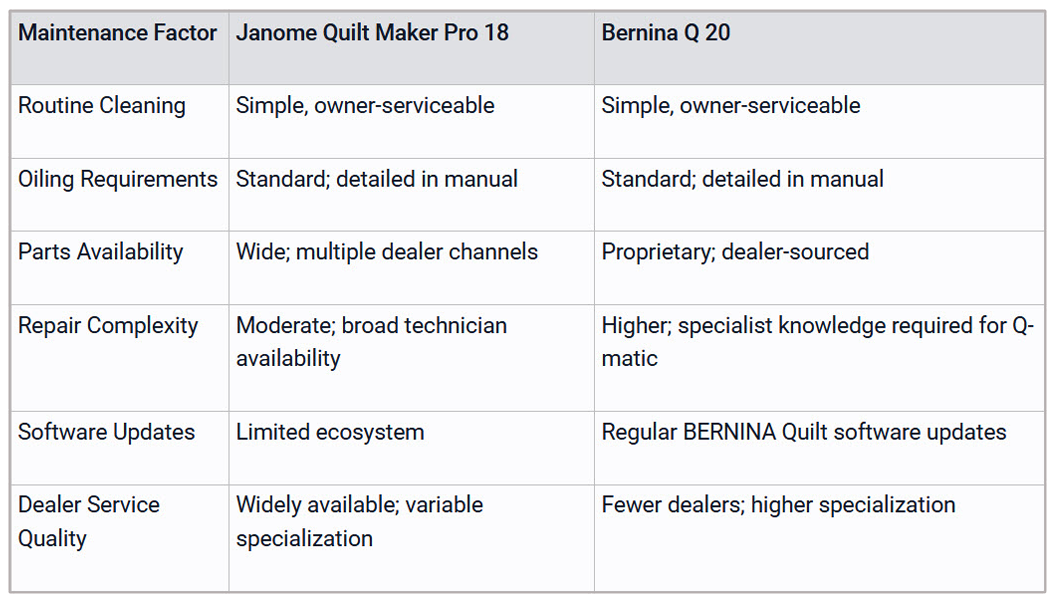
You largely can't self-service it. This is the loudest recurring complaint from experienced longarmers. The threading path is internal, and the tension check spring isn't user-accessible without removing part of the housing. Owners of brands like APQS and Innova routinely change check springs, reset timing, or adjust the needle bar themselves; on a Bernina, even minor issues can mean hauling the (roughly 38–50 lb) machine head to a dealer. There have also been scattered reports of check-spring breakage on the Q24.
Dealer dependence is total. No self-service plus dealer-only sales makes a competent nearby Bernina dealer essentially mandatory. And owners report uneven dealer expertise, including new buyers whose salesperson couldn't even thread the machine.
All-electronic tension isn't for everyone. Tension is touchscreen-controlled with no visible physical spring to eyeball, which some traditional longarmers dislike.
Sit-down models are slow on big quilts. A common Q20 sit-down comment: a king-size project can live under the needle for weeks, whereas a stand-up frame would fly through it.
Janome's Real Weaknesses
Thinner long-term track record and resale. The own-branded line is younger than the established names, so there's less owner data, a less-developed used market and more resale uncertainty if you move it on.
Parts and support friction on older units. Owners of earlier Janome longarms have reported real difficulty sourcing worn components, with dealers and the brand slow to help.
Fewer hands-on dealers to test-drive. You may have to travel to try one, and with a purchase this size, test-driving first is strongly advised.
No premium cachet. It quilts beautifully but doesn't carry the status or the resale halo of the Swiss name.
On the positive side, Bernina owners tend to be devoted: multi-year Q20/Q24 owners report consistently excellent stitch quality, minimal tension trouble, and deep affection for the BSR. Janome owners report a smooth on-ramp, genuinely useful business tools, and Pro-Stitcher integration that works as advertised.
Space and Total Cost of Ownership
The sticker price is only the start. Two things blindside first-time buyers.
Space
A full-frame longarm is furniture you build a room around. A typical 10-foot frame wants a room about 12–14 feet long and roughly 8 feet wide for access on all sides (frames run 10–14 ft long by 2.5–4 ft deep). Push one side to a wall and you can drop to about 10–12 feet of width, but you'll lose back-of-frame access, which matters for pantographs.
No dedicated room? The "sit-down models" (Janome's Versa, Bernina's Q16/Q20 on a table) need only about a large-desk footprint.
Ongoing Costs and Friction.
Budget beyond the machine for the frame size you choose, automation (Pro-Stitcher or Q-matic, several thousand dollars on top), needles/bobbins/thread, and periodic servicing. Two cost notes worth weighing: Bernina's standard needles keep consumables cheap and easy to source, while its no-self-service design pushes more maintenance onto paid dealer visits. And remember, the biggest hidden cost of all: you essentially can't return a long arm. Buy wrong, and you eat the resale loss, which is why seasoned quilters advise spending months researching and test-driving across brands before committing.
Reliability, Warranty, and Service
These are decade-long investments, so long-term support matters as much as the spec sheet.
Janome's longarm warranty carries roughly 25 years on mechanical parts, two years on electrical, and one year labor (terms vary by dealer; some quote five years on electronic components).
Bernina's Q Series carries 20 years mechanical, five years on circuit boards, and two years electrical, with dealers often adding a year of parts and labor. Both are excellent, long mechanical warranties.
Service and dealer networks are where they diverge. Janome operates one of the largest dealer networks in the industry, with service centers in most metro and many regional areas, meaning faster repair turnaround, easier in-person demos, and competitive pricing. If you're rural, Janome's broader coverage is a genuine practical advantage.
Bernina's network is smaller but specialized: authorized dealers receive brand-specific training, and those servicing Q Series machines know the Q-matic system well. Combined with Bernina's limited self-service design, that makes a knowledgeable nearby Bernina dealer close to essential.
Before buying either, identify your nearest authorized service center and ask directly about their longarm experience. A dealer who knows the machine inside-out is worth more than headline warranty numbers.
Janome Is the Better Fit If…
The Quilt Maker Pro 18 suits the serious home quilter or small longarm service provider who wants professional stitch quality, a manageable learning curve, and strong value without crossing into $15,000–$20,000 territory. Consider Janome if:
- You're transitioning from a domestic machine to your first longarm
- Your primary style is freehand, pantograph, or ruler-based work
- You want a complete, ready-to-quilt setup under $10,000
- You like that you're buying the proven Handi Quilter/Pro-Stitcher platform at a lower price
- You value dealer proximity and parts accessibility (especially if rural)
- You're comfortable with a younger resale market in exchange for the savings
Bernina Is the Better Fit If…
The Q20 (or Q24) with Q-matic is built for quilters who want the most refined, capable system in the home and semi-professional market. Consider Bernina if:
- You operate or plan to start a longarm quilting business
- Computerized, automated quilting is central to your workflow
- You want tight integration between design software and machine execution
- You value the BSR's refinement, standard-needle convenience, and strong resale
- You have a knowledgeable Bernina dealer within reasonable driving distance
- You're happy to let the dealer handle maintenance rather than tinkering yourself
- You're comfortable investing $15,000–$28,000+ for a forever machine
The Verdict
There's no universal winner, and any comparison claiming one is oversimplifying. Janome wins on value, while Bernina wins on refinement," and those serve genuinely different quilters.
If value is your metric (the best quilting performance per dollar) the Janome Quilt Maker Pro 18 is hard to beat. It delivers show-quality results on the proven Handi Quilter platform at a price that makes longarm quilting accessible to far more people, with the trade-offs of a younger resale market and a less premium feel. For most quilters reading this, it's the smarter financial decision.
If refinement and automation define quality for you, and you'll actually use what you're paying for, then the Bernina Q20 with Q-matic justifies its premium, provided you have the budget, a good dealer nearby, and no desire to service the machine yourself. For professionals and serious enthusiasts who want the best, it earns its price.
Decide what matters most: your budget; your studio space; or owning a forever machine. "Test-drive before you buy" advice, and the right choice becomes clear. Either way, both brands will get you off the dining-room table and onto a whole new level of quilting.
<< Previous | Next >>