

Janome vs Bernina Longarm Quilting Machines
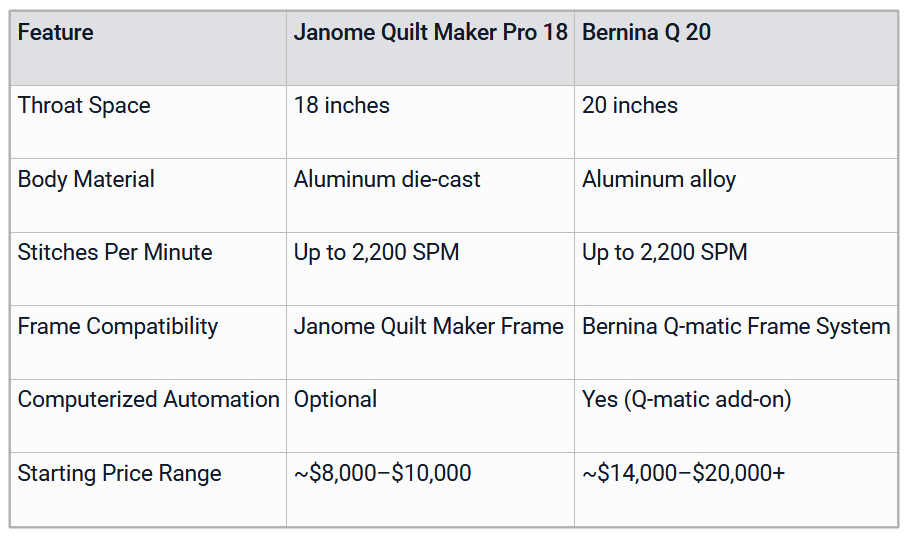
Janome's lineup centers on the Quilt Maker Pro 18 (18" throat, 2,200 SPM, configurable 4'/8'/12' frame). Bernina's core longarms are the Q16 Plus (16.5"), Q20 (20"), and Q24 (24"), all built to Swiss assembly standards.
Labor and wear-part terms vary by dealer and region. Read the fine print before buying.
Janome Construction
The Quilt Maker Pro 18 mounts on a purpose-built frame with smooth carriage movement, large M-class bobbins (more thread, fewer changes), a low-bobbin estimator, and built-in business tools (project timers and stitch counters) that genuinely help if you quilt for clients. Stitch regulation runs in two modes: precision (stitches form as you move) and cruise.
Bernina Construction
The Q Series is designed, engineered, and assembled in Switzerland, and it shows in fit, finish, and low vibration. Owners comparing brands at shows routinely single out Bernina's frame as the most solid. The BSR (Bernina Stitch Regulator) uses dual optical sensors and is one of the most responsive in the industry, and one genuinely underrated perk is that the machine uses standard Bernina needles and feet - no proprietary consumables.
Stitch Quality and Consistency
Both machines deliver show-quality stitching; they get there differently. Janome's regulator is reliable and consistent across freehand speeds. Bernina's BSR responds faster and integrates more tightly with the touchscreen controls - an edge that becomes noticeable in dense, high-detail custom work. For the majority of quilters, both produce excellent results; the difference surfaces under professional, high-volume conditions.
Throat Space and the Reality Check
Throat space is the distance from the needle to the machine body, and it sets how much quilt you can work on at once. The Janome Pro 18 offers 18", while the Bernina Q20 offers 20". The Q24 stretches to 24" for king-size quilts with minimal re-rolling.
But here's the part the brochures skip: the advertised throat is not the usable throat. Between the hopping foot, rollers, and take-up, an 18" throat realistically yields about 14"-15" of working space, and a 20" throat yields about 16"-17". So when you weigh 18" against 20", judge the difference (a couple of usable inches), not the headline numbers. That single fact keeps buyers from overpaying for inches they'll never use.
Automation: Pro-Stitcher vs. Q-matic
This is a major upgrade path for both - and where the two ecosystems diverge.
Janome Pro-Stitcher. As covered above, this is Handi Quilter's mature, widely adopted automation platform: a deep design library, broad cross-brand community support, and abundant tutorials. It drives the machine through edge-to-edge and custom designs.
Bernina Q-matic + Art & Stitch. Q-matic is Bernina's automation system, bundled with Art & Stitch design software (note: the design suite is Art & Stitch/Q-matic and not a product called "Bernina Quilt"). It ships with 600+ designs, lets you create and digitize your own patterns, imports non-proprietary formats, and uses precision stepper motors to execute designs autonomously across the quilt, allowing you to walk away while it stitches.
Both are genuinely capable robotic systems; this is not a case of one brand having automation and the other not. The practical differences: Pro-Stitcher's broad adoption means more shared resources and a larger user community, while Q-matic is tightly integrated into Bernina's premium ecosystem. Either way, automation adds several thousand dollars noticeably, more on the Bernina side (the Q-matic system alone runs around $17,000).
The trade-off with either system is the learning curve: importing designs, calibrating the frame, and translating digital patterns to physical quilts all take dedicated study time. Both reward quilters who commit to learning them.
<< Previous | Next >>